
Choosing among the 2026 Best L-CNG Refueling Station Manufacturers requires more than comparing quoted prices. An L-CNG/CNG Refueling Station combines cryogenic storage, pumps, vaporizers, compressors, controls, and dispensers. Each component must work as part of one operating system. A polished brochure cannot show how reliably a pump handles repeated starts or how clearly alarms appear in a control room.
Argonne transportation-fuels researcher Michael Wang has emphasized evaluating fuels through their broader system performance. A useful station-buying paraphrase of that principle is: “Judge the whole operating system, not one impressive component.” This is a paraphrase, not a verbatim quotation. For buyers, that means checking documented flow rates, pressure stability, energy use, service response, and commissioning records. Ask manufacturers to explain how their equipment performs during cold starts, peak demand, and routine maintenance. Look for specific evidence, not vague promises. Small details matter: spare seals, readable wiring diagrams, and a technician who can diagnose a pressure drop.
This guide compares manufacturers through practical criteria, including engineering capability, customization, safety features, lifecycle support, and reference installations. It also recognizes an uncomfortable point: published specifications do not guarantee performance at every site. Local conditions, operator training, and maintenance habits can change results. Use the shortlist as a starting point, then verify claims with technical documents and customer references before making a decision.
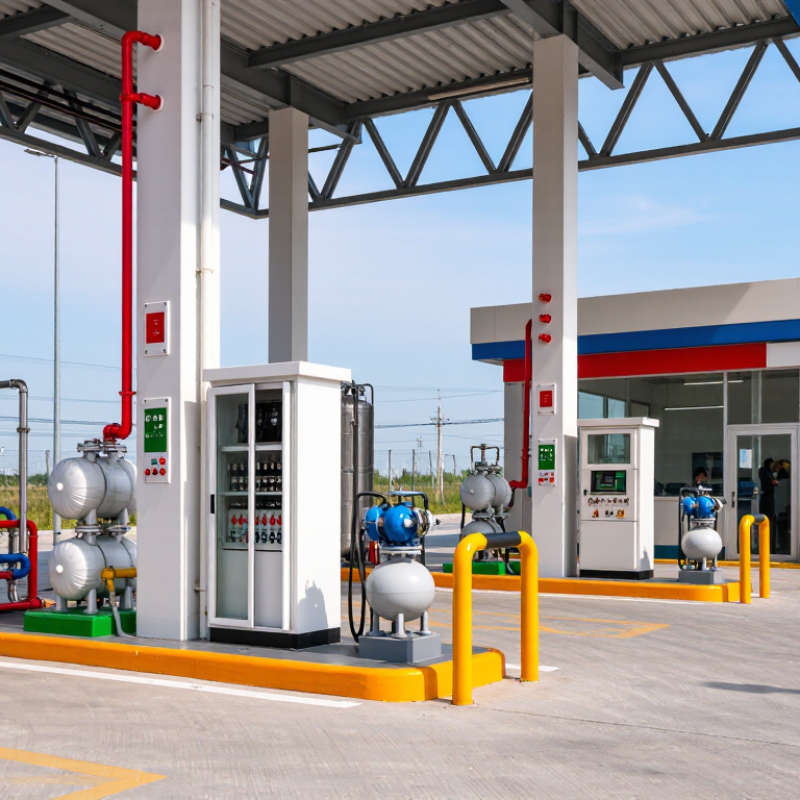
An L-CNG station stores LNG in an insulated tank, typically near −162°C. A cryogenic pump raises the liquid’s pressure before it enters a vaporizer. Because the liquid is pressurized first, the station avoids compressing warm gas through multiple stages. The vaporizer then adds heat, turning high-pressure LNG into natural gas for vehicle fueling. The target is commonly 20–25 MPa. The U.S. Department of Energy’s Alternative Fuels Data Center lists 3,600 psi, about 24.8 MPa, as a common CNG vehicle storage pressure. That sits near the upper end of this range. Details matter.
At the dispenser, controls monitor pressure and temperature, while relief devices and shutdown systems help manage abnormal conditions. Vaporizer performance can change with weather and operating demand; a neat process diagram rarely shows that variation. Not always so tidy. The GIIGNL 2024 Annual Report records 401.42 million tonnes of LNG traded worldwide in 2023, evidence of a large supply chain feeding these stations. Yet reliable station operation still depends on careful equipment sizing, insulation, and maintenance. Operators should check for frost buildup, leaks, and pressure swings during routine inspections. A small detail can matter.
For an L-CNG station, storage capacity is useful only when it matches daily demand and delivery schedules. The U.S. Department of Energy’s Alternative Fuels Data Center notes that liquefied natural gas occupies about 1/600 the volume of natural gas at standard conditions. That compact storage can help sites with limited space. Still, ask for usable tank capacity, not just gross volume. Leave room for operating limits and reserve stock.
Flow rate needs equally careful checking. Compare dispenser delivery rates under stated pressure and temperature conditions, then ask how many vehicles can refuel at once. A peak figure alone can mislead. Real-world throughput may fall when several dispensers run together or equipment warms up. Power use deserves the same scrutiny: request kWh per kilogram dispensed and peak electrical demand, including pumps, controls, and vaporization equipment. These figures make operating-cost comparisons more meaningful than motor ratings alone.
Tips: Ask for test data from a duty cycle close to your site’s. Confirm what the supplier includes in its power figures. Small differences in test conditions matter. I would also check maintenance assumptions; they are easy to overlook, and published specifications rarely tell the whole story.
2026 Best L CNG Refueling Station Manufacturers?
For an LCNG station, standards matter most where equipment interfaces meet. ISO 16923 addresses CNG fuelling stations, while ISO 16924 covers LNG fuelling stations. An LCNG design may combine LNG storage and pumping with high-pressure gas delivery. Buyers should check which standard applies to each process area, rather than assume one certificate covers the entire installation.
Review pressure ratings, materials, emergency shutdown logic, ventilation, and gas detection in the actual equipment documents. Ask how the supplier manages the transition between cryogenic liquid and compressed gas. Request test records and clear operating limits, not just a standards statement. Small details matter: a sensor’s location or a valve’s response time can affect safe operation. Compliance is essential, but it does not prove a station will perform well in every climate or duty cycle.
Tips: Compare documented design scope, inspection records, and maintenance access. Confirm applicable standard editions and local requirements with qualified reviewers. Look closely at interfaces. They are easy to overlook, and I would not treat paperwork alone as proof of field reliability.
| Comparison Dimension | CNG Refueling Stations — ISO 16923 | LNG Refueling Stations — ISO 16924 | What to Verify When Comparing Equipment |
|---|---|---|---|
| Standard scope | Addresses CNG stations that fuel vehicles with compressed natural gas. | Addresses LNG stations that fuel vehicles with liquefied natural gas. | Confirm which standard applies to each station system and component. A standard is not, by itself, a manufacturer ranking or product certification. |
| Fuel condition at dispensing | Natural gas is stored and dispensed as a compressed gas. | Natural gas is stored and dispensed as a cryogenic liquid. | Check that the selected equipment is designed for the fuel state, pressure, temperature, and operating conditions stated for the project. |
| Typical major equipment | May include gas compression, storage cascades, priority control, gas cooling where required, and CNG dispensers. | May include LNG storage tanks, transfer pumps or pressurization equipment, cryogenic piping, and LNG dispensers. | Review the station process diagram and equipment schedule; the actual configuration depends on capacity, site conditions, and vehicle requirements. |
| Pressure and temperature hazards | Equipment and piping must be suitable for the specified high-pressure gas service. | Equipment and piping must be suitable for cryogenic liquid service and the applicable pressure conditions. | Request documented design ratings, materials compatibility information, and operating limits for the intended service. |
| Safety and protective design | Station design should address foreseeable gas-release, ignition, overpressure, and vehicle-fuelling hazards. | Station design should address foreseeable LNG-release, cryogenic-contact, vaporization, ignition, and vehicle-fuelling hazards. | Review the project-specific hazard assessment, protective systems, emergency arrangements, and applicable local fire and building requirements. |
| Controls and emergency functions | Control and emergency functions should match the station design and its identified hazards. | Control and emergency functions should account for LNG storage, transfer, dispensing, and the station’s identified hazards. | Ask for control descriptions, shutdown logic, alarm functions, and evidence that safety functions have been tested and documented. |
| Inspection and maintenance | Inspection and maintenance planning should reflect the station design, equipment, and operating conditions. | Inspection and maintenance planning should reflect cryogenic equipment and the station’s operating conditions. | Compare maintenance instructions, inspection records, spare-parts provisions, and staff training requirements for the offered configuration. |
| L-CNG or LNG-to-CNG configuration | Relevant to CNG dispensing and associated compressed-gas equipment, depending on the station layout. | Relevant to LNG storage and handling equipment, depending on the station layout. | For an LNG-to-CNG station, assess the LNG system and the downstream gas-processing, compression, storage, and dispensing systems separately. Confirm the applicable standards and local rules for the complete installation. |
| Evidence for a procurement review | Request the design basis, equipment specifications, operating instructions, and conformity documentation applicable to the project. | Request the design basis, cryogenic equipment specifications, operating instructions, and conformity documentation applicable to the project. | Check that documentation identifies the exact equipment configuration and applicable editions of standards; do not rely on a general claim of “ISO compliant.” |
Note: ISO 16923 and ISO 16924 describe different station types; they are not interchangeable. This overview is for preliminary comparison only and does not reproduce the standards or replace a project-specific engineering, regulatory, or conformity assessment.
For an L-CNG refueling station, compare manufacturers by usable daily capacity, not headline figures alone. Ask how the system performs during peak hours and cold weather. A clear proposal should state LNG storage volume, pump output, dispensing rate, and expected operating hours. Check whether those figures assume continuous use or include realistic pauses for vehicle turnover. Small differences matter.
Certification needs careful review. Request documents for the equipment supplied, pressure components, electrical systems, and control panels. Confirm that certificates match the proposed configuration and the requirements of the installation location. A certificate for one component does not automatically cover an entire station. Details matter. A neat brochure can still leave gaps.
Automation should make operation safer and easier to monitor, with clear alarms, pressure readings, and accessible shutdown controls. Ask for a live system demonstration or sample operating screens. Service is just as important: compare commissioning support, operator training, spare-parts availability, and response times. Get those commitments in writing. I would also ask what happens when a sensor fails on a busy day; that answer may reveal more than a polished presentation. No manufacturer can remove every operational risk, so practical maintenance instructions and straightforward fault reporting deserve real weight.
Selecting an L-CNG station supplier means looking beyond the quoted equipment price. Compare electricity use, cryogenic pump and compressor maintenance, dryer replacement, spare-parts availability, and service travel costs across a realistic operating life. Model your own throughput and local energy prices; a busy depot and a lightly used public station will not share the same economics. Ask suppliers for commissioning records and measured energy consumption, not estimates alone. Uptime needs evidence.
Define uptime in the contract, including planned maintenance, response times, and how downtime is recorded. Check whether critical pumps, controls, and dispensers have practical backup arrangements. The International Energy Agency’s Global Methane Tracker 2024 estimated that fossil fuel operations released about 120 million tonnes of methane in 2023. The IPCC’s Sixth Assessment Report assigns fossil methane roughly 30 times the warming impact of CO2 over 100 years. These figures cover the wider fossil-fuel system, not an individual station, but they make leak detection and documented maintenance relevant selection criteria. Compare emissions using measured leakage, electricity mix, and gas supply assumptions. Those assumptions can be imperfect; require suppliers to show their calculation method, and revisit it after the station has operated through a full seasonal cycle.
Copyright © 2025 · All Rights Reserved · Franchino Mold & Engineering