
Choosing the best Pool Accessories from China requires more than comparing prices. It requires evidence, testing, and practical poolside experience. Buyers should examine material grades, supplier audits, warranty terms, packaging quality, and replacement-part availability before placing an order.
Industry data supports this careful approach. Grand View Research’s Swimming Pool Equipment Market Report identifies rising demand for filtration, cleaning, heating, and water-management equipment worldwide. Its findings suggest that buyers increasingly value efficiency and dependable performance, not only low purchase costs. The Pool & Hot Tub Alliance’s 2024 industry reporting also highlights stronger attention to maintenance, water quality, safety, and professional installation. These priorities apply directly to Chinese-made ladders, covers, pumps, skimmers, robotic cleaners, lighting, and testing tools.
Joe Vassallo, a recognized pool-industry educator and president of Paragon Pools, often emphasizes a practical principle: “A pool is only as good as its maintenance.” That idea should guide every sourcing decision. A sleek LED light means little if its seal fails after one rainy season. A cheap vacuum is not a bargain when its hose cracks beside a busy hotel pool. Still, product selection is rarely perfect. Certifications can be misunderstood, specifications may be incomplete, and supplier photographs can hide weak finishing. This guide therefore compares function, compliance, durability, and total ownership cost. China offers broad manufacturing capability. Careful verification remains essential.
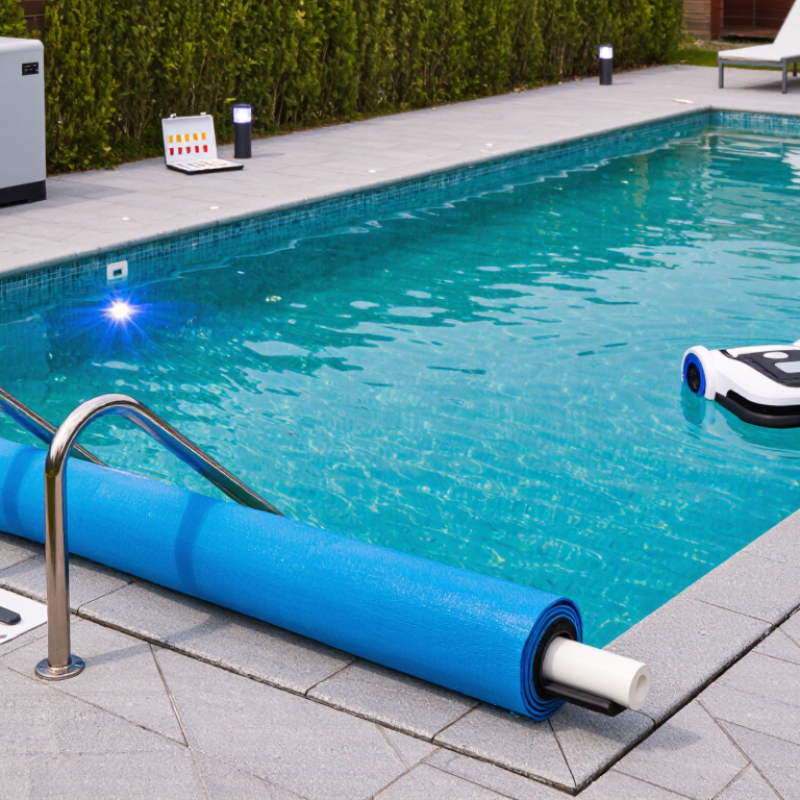
China’s strongest pool accessory range covers pumps, filters, covers, lights, and safety equipment.
For pumps, variable-speed models deserve attention. The EPA ENERGY STAR program reports that certified pool pumps can use up to 65% less energy than standard models. Ask suppliers for flow curves, motor efficiency data, noise readings, and saltwater compatibility. Do not judge by motor size alone. A powerful pump may waste energy when the filter is undersized.
Filters need a practical match. Cartridge filters simplify cleaning, while sand filters suit larger pools and frequent use. Request pressure ratings, replacement-media costs, and test results for water clarity.
Covers should resist ultraviolet exposure, tearing, and standing water. Automatic covers improve convenience, but installation quality remains critical.
Pool lights need sealed housings, low-voltage systems, and stable underwater connections. One missed gasket can create a serious failure.
Safety accessories require more than appearance. The WHO’s 2024 drowning fact sheet reports over 230,000 drowning deaths annually worldwide, reinforcing the need for layered protection.
Consider compliant barriers, self-closing gates, alarms, rescue poles, and clearly marked depth signs. Suppliers should provide material certificates, batch records, and independent test reports. Ask for pre-shipment inspection photos.
Small details matter.
A cheaper cover may crack early, and a bright light may still have poor sealing. Product selection should include installation conditions, maintenance access, and local electrical requirements.oreferrer
Pool accessories from China deserve closer technical scrutiny, especially filtration equipment. Industry comparisons cited in PHTA technical guidance commonly place sand filters around 20–40 μm, cartridge filters near 10–15 μm, and D.E. filters around 2–5 μm. These figures describe typical particle-capture ranges, not guaranteed results. Filter media, water speed, pressure, and maintenance can change performance.
A 30 μm sand bed may leave fine dust visible on a sunny pool floor. A cartridge can catch smaller particles, but its pressure gauge may rise quickly after heavy use. D.E. filtration usually produces the clearest water, although it requires careful powder loading and disposal. NSF/ANSI 50 testing frameworks also remind buyers to examine flow rate, structural strength, and sanitation compatibility, rather than focusing only on micron claims. Small print matters.
When evaluating Chinese-made accessories, request independent laboratory reports and batch-level quality records. Check whether the rating is nominal or absolute. Confirm replacement dimensions, maximum flow, operating pressure, and gasket material. In practical testing, measure pressure before and after filtration, then inspect water clarity under controlled lighting. A lower micron number is not automatically better. I have seen restrictive filters polish water beautifully while increasing pump load. That trade-off needs honest review.
| Filter Type | Typical Particle-Removal Range | Typical Pressure Rise Before Cleaning | Cleaning Method | Typical Cleaning Frequency | Water Clarity | Main Advantages | Main Limitations | Best-Fit Pool Use |
|---|---|---|---|---|---|---|---|---|
| Sand Filter | Approximately 20–40 μm under typical operating conditions | About 0.7 bar / 10 psi above the clean starting pressure | Backwash, followed by a short rinse cycle | Commonly every 2–6 weeks, depending on debris load and water conditions | Good; usually the least fine of the three options | Simple operation, durable media, easy backwashing, and no disposable cartridge required | Lower fine-particle capture; uses water during backwashing and requires a larger installation footprint | Large residential pools, public pools, and installations where low-maintenance cleaning is important |
| Cartridge Filter | Approximately 10–15 μm with a clean, properly sized cartridge | About 0.35–0.50 bar / 5–7 psi above the clean starting pressure | Remove the cartridge and rinse pleats with a hose; periodic deep cleaning may be required | Usually every 1–3 months, depending on pool use and contamination | Very good; captures finer particles than standard sand filtration | Lower water consumption, compact design, and no backwash line required | Manual cleaning is required; cartridges eventually need replacement | Residential pools with water-use restrictions or limited equipment-room space |
| D.E. Filter | Approximately 2–5 μm when correctly charged with filter-grade diatomaceous earth | About 0.7 bar / 10 psi above the clean starting pressure | Backwash or internal cleaning, followed by replacement of the D.E. powder | Often every 1–3 months, or whenever the pressure-rise limit is reached | Excellent; generally the finest filtration among common pool filter types | Strong fine-particle removal and high potential for visibly clear water | Higher maintenance complexity, powder handling, and disposal requirements | Pools prioritizing maximum clarity, including high-use residential or commercial settings |
Choosing a Chinese pool pump starts with flow, head, and verified compliance. Flow describes the water volume moved per minute. Head measures resistance from pipes, filters, fittings, and elevation. A pump’s advertised maximum flow can mislead. It usually occurs at nearly zero resistance.
For example, a 20,000-gallon pool needing an eight-hour turnover requires about 42 gallons per minute. The final pump must deliver that flow at the system’s total dynamic head. Measure pipe length, elbows, filter resistance, and return height carefully. A pump curve should show the operating point clearly. My first estimates were once too optimistic because I ignored a restrictive filter. That mistake increased energy use.
NSF/ANSI 50 documentation adds another layer of confidence. Check whether the exact pump model, not only the factory, is covered by a current certification or accepted evaluation. Request test records, material details, electrical data, and traceability documents. Confirm suitability for the destination’s voltage and installation rules. Look for corrosion-resistant components and stable performance during continuous operation. Small details matter. Noise and service access matter too. A slightly smaller pump, correctly matched to the head, may perform better than an oversized unit. Some supplier specifications remain incomplete, so independent verification is still necessary.
What Are the Best Pool Accessories from China?
Pool accessories from China can offer strong value, but safety must lead selection. Drain covers deserve special attention. The World Health Organization’s 2024 drowning fact sheet estimates 236,000 annual drowning deaths worldwide. That figure makes small design details important. A cover should match the drain body, flow rate, fastener pattern, and service life. ANSI/APSP-16 evaluates suction fittings, including hydraulic performance and hair, body, and limb entrapment risks. Ask suppliers for the exact standard edition, test scope, and installation limits. A generic “tested” label is not enough.
For ladders, handrails, grilles, and other accessories, EN 13451 testing provides a useful European reference. Requirements address dimensions, stability, load resistance, corrosion, and user safety, depending on the product section. Request complete laboratory reports, not cropped certificates. Confirm the model number matches the production sample. An ISO/IEC 17025-accredited laboratory adds credibility, although accreditation cannot fix poor installation. Inspect screw seats, rounded edges, welds, and exposed metal. I have seen attractive samples fail through mismatched holes or weak fasteners. That is an uncomfortable lesson.
Tips: Keep the test sample and installation drawing together. Measure suction flow on site. Replace cracked covers immediately. Recheck fasteners after commissioning and heavy use. Do not assume a higher load rating solves entrapment. Local rules may demand additional checks, so obtain written approval from a qualified safety professional.
Choosing the best pool accessories from China starts with supplier verification, not attractive photos or low prices. I have found that an ISO 9001 certificate is useful, but it does not prove every product is reliable. Check the certificate number, issuing body, factory address, and validity date. Ask whether the certified factory actually makes your pool lights, pumps, ladders, or cleaning tools.
IP ratings deserve careful attention. An IP68 claim may describe water resistance under specific laboratory conditions, not permanent pool use. Request the complete test standard, sample details, test depth, duration, and laboratory name. Professional test reports should include model numbers matching your quotation. Generic reports create doubt. Ask for recent production samples, then inspect seals, cable joints, packaging, and corrosion protection before placing a large order.
MOQ can affect both cost and quality control. A low MOQ may help a small buyer test demand, while a higher MOQ can support custom colors or packaging. Confirm whether the MOQ applies to each model, color, or shipment. I also recommend a pre-shipment inspection with photographs and measurable results. Review voltage, dimensions, materials, noise, and leakage protection. Do not rely only on factory promises.
There is no perfect checklist. Suppliers may provide valid documents but still deliver inconsistent batches. Keep communication records, approve a golden sample, and use clear acceptance criteria. Small details matter. A careful verification process reduces surprises, although it cannot remove every purchasing risk.
Supplier verification checklist: ISO 9001, IP ratings, MOQ, and professional test reports
Check the certificate scope, certification body, validity period, and manufacturing site.
Under IEC 60529, the second IP digit indicates water protection: 4 splash-resistant, 5 water jets, 6 powerful water jets, and 7 temporary immersion.
MOQ is supplier-specific. Confirm the quantity by product model, color, packaging, and customization level.
Verify the applicable standard, tested product model, test date, laboratory details, and report authenticity.
Copyright © 2025 · All Rights Reserved · Franchino Mold & Engineering