
China’s stainless steel manufacturing base makes it an important sourcing destination for marine, lifting, construction, and industrial hardware. The International Stainless Steel Forum (ISSF) reported global stainless crude steel production at approximately 58.4 million tonnes in 2023. China represented the largest producing region, supporting a broad ecosystem of forging, casting, machining, polishing, and export services.
This guide examines China’s leading Stainless Steel Shackles manufacturers through practical purchasing criteria. These include material grade, working load limit, pin design, surface finish, traceability, testing, and production capacity. A shackle may look simple on a warehouse shelf. Its threads, shoulder contact, and pin alignment can determine performance under repeated loading. Common materials include 304 and 316 stainless steel, but grade selection should match saltwater exposure, corrosion risk, and temperature conditions.
Standards matter.
ASME B30.26, EN 13889, and relevant ISO requirements provide useful reference points for dimensions, marking, inspection, and safe use. However, compliance claims require verification from controlled documents, not attractive product photographs. UN Comtrade trade data can help evaluate export activity, while ISSF statistics provide broader context for stainless steel supply and regional production. Manufacturer audits should also review mill certificates, load testing records, quality systems, and sample consistency.
No supplier list is permanently perfect. Factories change equipment, subcontract processes, and product lines. That limitation deserves attention. A reliable guide must therefore compare documented capability with physical samples, third-party inspection, and clear communication. The following overview focuses on manufacturers that show credible evidence, practical expertise, and consistent export readiness.
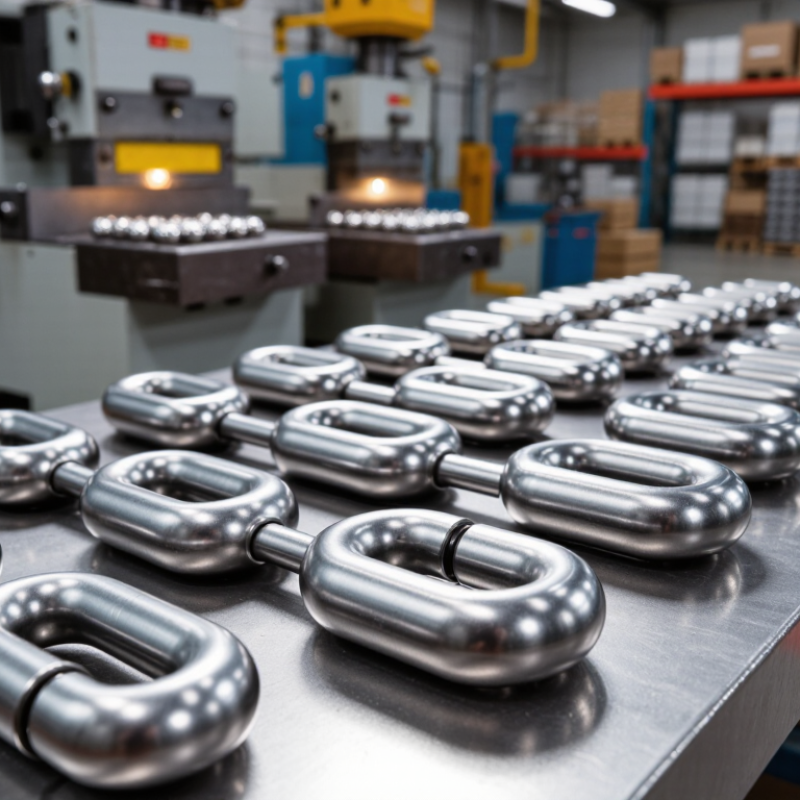
China Top Stainless Steel Shackles Manufacturers Guide
Stainless steel shackles differ by shape, pin design, and material grade. D shackles suit straight-line loads and narrow connections. Bow shackles allow wider sling angles and better movement. Screw-pin models support frequent assembly, while bolt-type shackles offer stronger security in permanent installations. These differences matter more than appearance.
Grade selection should match the environment. Grade 304 provides reliable corrosion resistance for indoor, marine-adjacent, and general industrial use. Grade 316 contains molybdenum and performs better around saltwater and chemical exposure. Some manufacturers also supply 17-4PH stainless steel for higher strength, but its corrosion performance requires careful evaluation. The International Stainless Steel Forum reported 58.4 million tonnes of global crude stainless steel production in 2023, showing the scale of this material market. Still, more steel does not automatically mean safer hardware.
Tip: Ask Chinese suppliers for material certificates, proof-load records, thread details, and traceable batch numbers. Check WLL, not breaking load. Confirm whether testing follows ASME B30.26, EN 13889, or another stated standard. A 316 shackle may resist salt better, yet poor pin fit or sharp loading can cause failure. This is often overlooked. I would also compare surface finish, marking quality, and dimensional tolerances before judging price. Manufacturer claims need verification.
Evaluating Chinese stainless steel shackle manufacturers requires more than comparing online prices. Request the factory’s legal registration, production address, and quality management certifications. A reliable supplier should explain its stainless steel grade clearly, such as 304 or 316, and provide material certificates for each batch. Ask how heat treatment, forging, machining, and polishing are controlled. These details reveal real manufacturing experience.
Inspect sample shackles closely. Check thread smoothness, pin fit, surface finish, and engraved markings. Ask for dimensional drawings and working load information. Independent tensile testing can verify whether the shackle meets its stated capacity. Review test dates, laboratory details, and sample identification. One polished sample proves little. Batch consistency matters more. Factory audits, video inspections, and production records can strengthen your judgment, although none is perfect.
Tips: Request three samples from different batches. Compare their weight, dimensions, and pin movement. Confirm packaging protects threads from scratches and moisture. Ask how complaints are recorded and corrected. Slow replies may signal weak technical support. However, fast replies are not proof of quality. I once treated certificates as decisive evidence; that was too simplistic. Manufacturing controls, traceability, and honest communication deserve equal attention. Keep every drawing, report, and agreed specification in writing before placing an order.
China’s leading stainless steel shackle manufacturers combine metalworking experience with disciplined quality control. They commonly produce bow, dee, screw-pin, and safety shackles for marine, lifting, and industrial applications. Experienced teams select 304 or 316 stainless steel according to corrosion exposure, strength needs, and operating temperature. That choice matters. A coastal installation may need stronger resistance to saltwater pitting than an indoor fixture.
Reliable factories use forging, precision machining, polishing, and controlled heat treatment where the design requires it. Each shackle should receive dimensional checks, thread inspection, and proof-load testing before shipment. Certificates should identify material grade, batch number, test method, and applicable standard. Clear records make supplier evaluation easier. Buyers should also ask how manufacturers control pin fit, surface cracks, and thread damage. Small defects can become expensive problems.
A capable Chinese manufacturer supports drawings, sample approval, packaging protection, and repeat production. Technical staff can review working load limits, safety factors, and installation conditions instead of simply copying a sketch. In my assessment, communication speed is useful, but documented answers matter more. One weakness deserves attention: some suppliers present polished samples while offering limited evidence for full-batch consistency. Requesting inspection reports and independent verification can reduce that uncertainty. The best partnership grows through measured testing, honest limitations, and regular feedback.
Material comparison for commonly specified stainless steel shackle grades. Values show the minimum chromium, nickel, and molybdenum content specified in ASTM A240 ranges, expressed as weight percentages.
Grade 316 and 316L contain molybdenum, which is commonly selected for improved resistance to chloride exposure compared with grade 304. Final shackle selection should also verify working load limit, heat treatment, dimensions, surface finish, traceability, and applicable certification.
China Top Stainless Steel Shackles Manufacturers Guide
Reliable stainless steel shackles begin with controlled material selection. Manufacturers should define the alloy, mechanical properties, and intended load environment before production. Common grades include 304 and 316 stainless steel, but the correct choice depends on corrosion exposure and service temperature. Each batch should carry a traceable heat number and material certificate, preferably under EN 10204 3.1 requirements.
Manufacturing controls include forging, machining, thread forming, and surface finishing. Operators must check pin diameter, body dimensions, thread engagement, and working load markings. ASME B30.26 and EN 13889 may provide useful reference points, depending on the market and application. Standards are not interchangeable. That detail is often missed. A clean, bright surface can still hide internal flaws, so visual inspection alone is insufficient.
Testing should include dimensional inspection, proof load testing, and tensile testing when required by the specification. Dye penetrant testing can help identify surface cracks after forging or machining. Test equipment needs calibration records, while inspection results should remain linked to each production batch. Independent laboratory verification adds credibility, especially for large orders or critical lifting work. ISO 9001 certification can demonstrate a controlled quality system, but it does not replace product testing. A certificate is evidence, not a guarantee. Manufacturers should also review rejected samples honestly, because recurring minor defects may reveal a larger process weakness.
| Quality Dimension | Applicable Standard or Reference | Manufacturing or Inspection Requirement | Typical Evidence or Record |
|---|---|---|---|
| Product classification | EN 13889; ASME B30.26; applicable Chinese lifting-equipment requirements | Define whether the shackle is intended for general lifting, rigging, marine use, or non-lifting applications. The working load limit must be clearly identified for the intended configuration. | Approved drawing, product specification, application statement, and rated-load chart |
| Stainless-steel material | ASTM A276/A276M; ASTM A479/A479M; EN 10088 series | The material grade should be selected according to corrosion exposure and mechanical-load requirements. Common austenitic grades include 304/304L and 316/316L; the selected grade must be stated on the purchase specification. | Mill test certificate showing heat number, chemical composition, mechanical properties, and product form |
| Chemical composition | ASTM A276/A276M or the material standard specified in the contract | Verify chromium, nickel, carbon, molybdenum, manganese, silicon, phosphorus, and sulfur values against the ordered grade. Low-carbon 304L or 316L may be specified where welding or improved resistance to sensitization is required. | Heat-analysis report and, when required, positive material identification report |
| Forging process | Approved forging procedure; material standard; EN 13889 where applicable | Forged bodies should have controlled grain flow, consistent section thickness, and no visible laps, cracks, folds, or harmful forging defects. Heat-treatment parameters should be controlled and traceable when required by the material grade. | Forging-process record, heat-treatment chart, operator record, and batch traceability |
| Design and load rating | EN 13889; ASME B30.26; project-specific engineering requirements | The body, pin, crown, and threaded components must be designed for the declared working load limit. The design should account for loading direction, sling angle, side loading, and intended pin configuration. | Design calculations, finite-element review where used, and approved technical drawing |
| Dimensional inspection | Approved product drawing and applicable product standard | Check body diameter, bow width, inside length, pin diameter, thread dimensions, hole alignment, and overall dimensions. Measuring equipment should be calibrated and suitable for the required tolerance. | Inspection report with actual measurements, drawing revision, and calibrated-equipment identification |
| Surface condition | ASTM A380/A380M; ASTM A967/A967M where chemical passivation is specified | Surfaces should be free from cracks, sharp edges, damaging laps, embedded iron, scale, and contamination. Cleaning and passivation should be controlled to restore a uniform corrosion-resistant surface after manufacturing. | Surface-inspection record, cleaning/passivation procedure, and treatment batch record |
| Thread and pin fit | Approved drawing; applicable thread specification; EN 13889 or ASME B30.26 where relevant | The pin must engage correctly, seat fully, and be removable without abnormal force. Threads should be clean, undamaged, and compatible with the specified pin and body. Safety features must operate as designed. | Thread-gauge record, assembly check, functional test, and visual inspection report |
| Proof-load testing | EN 13889 or the load-test requirement stated in the purchase order | Apply the specified proof force using calibrated equipment and the correct loading arrangement. The test load, holding time, and acceptance criteria must follow the selected standard or approved test procedure. | Proof-load certificate showing serial or batch number, applied load, equipment calibration, and result |
| Tensile or breaking-load verification | EN 13889; customer-approved destructive-test plan | Where required, a representative sample is loaded to failure to validate design capacity. Destructive testing should be performed on a defined sampling basis and must not be substituted for routine proof testing unless approved. | Laboratory test report, load-versus-displacement data, failure mode, and sample traceability |
| Non-destructive examination | ASTM E1444/E1444M for magnetic-particle testing where applicable; ASTM E1417/E1417M for liquid-penetrant testing | Liquid-penetrant testing is generally suitable for detecting surface-breaking discontinuities in nonmagnetic stainless steels. Magnetic-particle testing is limited by the magnetic properties of the material and must be technically justified. | NDT procedure, qualified personnel record, inspection map, indications, and disposition |
| Corrosion-resistance verification | ASTM A967/A967M; ASTM B117 only when a salt-spray test is specifically required | Corrosion performance depends on alloy, surface condition, cleaning, passivation, environment, and maintenance. A salt-spray duration should not be treated as a universal service-life prediction for stainless-steel shackles. | Passivation test record, corrosion-test report when specified, and environmental suitability statement |
| Marking and traceability | EN 13889; ASME B30.26; applicable regulatory marking rules | Permanent marking should identify the working load limit, size or designation, material or grade where required, and traceability information. Markings must remain legible after normal handling and inspection. | Photographic marking record, batch or heat-number register, and product identification list |
| Quality-management system | ISO 9001:2015 | A quality-management system should control contract review, purchasing, production, inspection, nonconforming products, corrective action, document retention, and calibration. | Valid certificate from an accredited certification body and documented quality procedures |
| Environmental management | ISO 14001:2015, when requested by the purchaser | The system should address chemical handling, wastewater, waste segregation, energy use, and environmental compliance. Certification supports management-system verification but does not replace product testing. | Current environmental-management certificate and relevant compliance records |
| Occupational health and safety | ISO 45001:2018, when requested by the purchaser | The system should control risks associated with forging, heat treatment, machining, chemical passivation, lifting operations, and pressure or load testing. | Current certificate, risk assessments, training records, and safety procedures |
| Final release inspection | Approved inspection and test plan | Confirm quantity, dimensions, marking, surface condition, assembly, proof-test status, documentation, packaging, and protection against contamination before shipment. | Final inspection report, certificate of conformity, packing list, and release authorization |
| Documentation package | Purchase specification and customer inspection requirements | The package should be consistent, traceable, and matched to the delivered batch. Certificates should identify the applicable standard, product designation, quantity, test results, and authorized approval. | Material certificate, dimensional report, proof-load certificate, NDT report, certificate of conformity, and user instructions |
Note: The applicable standard, working load limit, test force, sampling frequency, and certification scope should be confirmed in the purchase specification for the intended lifting or rigging application.
A reliable order begins with clear specifications. State the shackle type, diameter, pin style, material grade, working load limit, and finish. Stainless steel 304 suits general environments, while 316 offers better resistance near saltwater. Ask for dimensional drawings, material certificates, and proof-load or inspection records. A sample can reveal thread fit, pin movement, and surface flaws before mass production. Small details matter.
Customization may include oversized pins, polished surfaces, laser markings, special openings, or protective packaging. Confirm whether changes affect strength or lead time. Request a written quotation showing tooling, minimum order quantity, inspection, packing, and shipping costs. The lowest unit price is not always economical. Freight can change the final figure sharply. I have seen buyers compare prices too early and miss testing fees. That approach needs reconsideration.
Tips: Agree on Incoterms, carton dimensions, and delivery terms before payment. Check the destination’s labeling and import requirements with a qualified customs professional. Ask for batch traceability and a pre-shipment inspection. Keep approved samples and drawings on file. Even careful sourcing can miss one tolerance. Recheck it.
Copyright © 2025 · All Rights Reserved · Franchino Mold & Engineering