
Choosing Ac Condensers in 2026 requires more than comparing prices and advertised cooling capacity. The right condenser must match the system, climate, refrigerant, installation space, and maintenance plan. A unit that looks efficient on paper may struggle beside a dusty roadside or under intense coastal humidity.
Dr. Armin Hafner, a respected refrigeration researcher, has stated, “A refrigerant choice is never only a technical choice; it is also an environmental choice.” That principle matters when evaluating modern Ac Condensers. Low-global-warming-potential refrigerants, including newer A2L options, are influencing equipment design and installation practices. Always verify current manufacturer instructions and regional requirements before purchasing.
This guide examines condenser types, heat-transfer surfaces, fan motors, coil protection, sound levels, and seasonal efficiency. It also considers microchannel and tube-fin designs, because each has practical strengths and weaknesses. Microchannel coils can reduce refrigerant volume and improve compactness. Tube-fin coils may offer easier field repair in some applications.
Sizing remains critical. An oversized condenser can cycle frequently, waste energy, and create unstable indoor comfort. An undersized unit may run continuously during a 38°C afternoon. That detail is easy to ignore.
Real conditions matter. Salt air, leaves, rooftop heat, and restricted airflow can shorten service life. I would not choose a condenser from a catalogue number alone. Laboratory ratings are useful, but they cannot represent every building, technician, or maintenance schedule. The best decision balances verified performance, long-term reliability, safe refrigerant handling, and realistic operating costs. Mistakes happen. Careful selection reduces their cost.
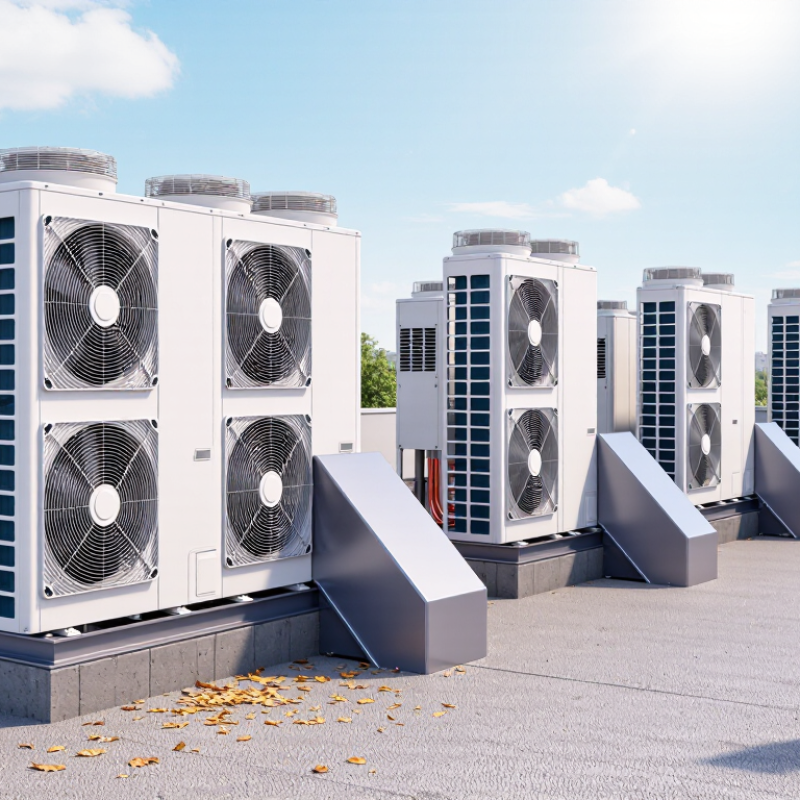
Selecting an AC condenser starts with the real cooling load, not the old unit’s nameplate. Calculate heat from walls, windows, occupants, lighting, equipment, and ventilation. A sunny room with west-facing glass may need much more capacity than its floor area suggests. Do not rely on a rough rule alone. It can produce an oversized system.
Cooling capacity is commonly shown in BTU/h or kW. Use this conversion: 1 kW equals approximately 3,412 BTU/h. For example, a 24,000 BTU/h load requires about 7.0 kW of cooling capacity. Keep the units clear on every quotation and calculation. Confusing electrical input with cooling output is an easy, costly mistake.
Climate changes condenser selection significantly.
Check the local outdoor design temperature, humidity, altitude, and airflow conditions. A condenser rated at mild outdoor temperatures may lose capacity during a 40°C afternoon. Leave practical clearance around the coil, especially near walls or dusty service areas. Coastal locations may also need stronger corrosion protection. Field inspections often reveal blocked airflow, even when the load calculation is correct. That detail is easy to miss. Compare the required capacity at actual design conditions, then verify operating limits, sound levels, efficiency, and service access in the technical data. A small safety margin can help, but excessive capacity may cause short cycling, poor humidity control, and unnecessary cost.
How to Choose AC Condensers in 2026?
Choosing an AC condenser in 2026 means matching the complete system to SEER2 and EER2 requirements. The condenser alone does not determine efficiency. The indoor coil, compressor, metering device, blower, and airflow also affect the final rating. SEER2 measures seasonal performance, while EER2 reflects efficiency under specific operating conditions. Both matter.
Check the equipment certification before comparing price or cooling capacity. Confirm the listed condenser and indoor coil form an approved combination. Then verify the rated SEER2 and EER2 values for your climate and system type. Requirements may differ between regions, replacement projects, and new installations. Local energy rules should guide the final decision.
Do not oversize casually. A large condenser can cool quickly but cycle poorly, leaving rooms damp. Correct airflow is equally important. Dirty filters, restricted ducts, or an incorrect refrigerant charge can reduce real-world efficiency. Field inspections often reveal this gap between laboratory ratings and installed performance. That gap deserves attention.
I would also examine service access, operating temperature range, sound levels, and control compatibility. A slightly higher-rated condenser may save energy, but only when installation quality supports it. Ratings can look impressive on paper. Ask for the full matched-system data, not a single efficiency number. Recheck the assumptions before ordering.
How to Choose AC Condensers in 2026?
Selecting an AC condenser now begins with refrigerant compatibility, not cabinet size. Under ASHRAE Standard 34, A2L refrigerants have lower flammability and require controlled ignition risks. The condenser must match the refrigerant charge, pressure range, oil type, expansion device, and approved piping limits. Small errors matter.
The numbers explain the shift. The U.S. Environmental Protection Agency’s 2024 Technology Transitions rule limits many new residential and light-commercial systems to refrigerants with GWP below 750. R-32 has a reported GWP of 675, while R-454B is approximately 466, according to industry refrigerant data. R-410A is about 2,088. Check the actual specification.
Look beyond efficiency ratings. Verify factory charge limits, leak-detection requirements, airflow controls, and service access around the condenser. The UNEP 2023 Cooling Emissions and Policy Synthesis Report warns that cooling demand and related emissions could rise sharply without better equipment and refrigerant management. A compliant condenser still needs correct installation.
Field experience suggests one weak point: documents are often checked too late. That is risky. Confirm the condenser, indoor coil, metering device, and refrigerant are listed as one approved combination. Also review local code requirements for A2L storage, recovery, ventilation, and technician training. Some product literature remains unclear, so pause before purchasing.
Compare commonly referenced stationary air-conditioning refrigerants by 100-year global warming potential (GWP). A2L refrigerants have lower flammability and require condensers specifically designed, tested, and listed for the selected refrigerant.
Safety classifications shown are from ISO 817 / ASHRAE 34 terminology. R-32, R-454B, and R-454C are classified as A2L; R-410A is A1. GWP values use commonly published AR4 100-year values. Always verify equipment labels, manufacturer specifications, local codes, charge limits, leak detection requirements, and service procedures before replacement.
How to Choose AC Condensers in 2026?
Coil design directly affects heat rejection, pressure drop, and maintenance. Microchannel coils usually reduce refrigerant volume and provide compact heat transfer. Finned-tube coils can tolerate field repairs more easily. I have learned that a thinner coil is not automatically better. Check fin spacing, tube layout, and corrosion resistance for the installation environment.
Airflow comes first. Measure it.
A dirty filter, blocked discharge path, or weak fan can erase the condenser’s design advantage. The U.S. Department of Energy reports that air conditioning uses about 6% of total U.S. electricity consumption. Poor airflow increases compressor stress and operating costs. Select a fan and coil combination that maintains stable airflow at the actual external static pressure, not only at laboratory conditions.
Heat-rejection capacity must match the local design temperature. The International Energy Agency projects global cooling demand could more than triple by 2050. That makes peak-weather performance increasingly important. Compare rated capacity, entering-air temperature, sound level, and power input using AHRI-certified test conditions. Still, test conditions are imperfect. A condenser exposed to afternoon sun, dust, and coastal moisture may perform differently. Leave practical safety margin, but avoid excessive oversizing, which can reduce cycling efficiency and complicate control.
| Condenser Design | Typical Coil Construction | Typical Fin Pitch | Recommended Face Velocity | Air-Side Pressure Drop | Heat-Rejection Capability | Weight and Footprint | Best-Fit Applications | Key Selection Consideration |
|---|---|---|---|---|---|---|---|---|
| Microchannel Coil | Flat multiport aluminum tubes with brazed or mechanically bonded fins; commonly arranged in two or more passes. | 14–22 fins per inch | 2.0–3.0 m/s | 80–180 Pa | High Approximately 1.5–2.2 kW per m² of face area under typical comfort-cooling conditions. | Low weight and compact depth; often 30–50% lighter than a comparable round-tube coil. | Packaged air conditioners, rooftop units, heat pumps, and space-constrained outdoor units. | Excellent compactness and low refrigerant volume, but fin damage, corrosion protection, and cleaning access require attention. |
| Round-Tube Plate-Fin Coil | Copper or aluminum round tubes expanded into aluminum plate fins; multiple circuits are used to control refrigerant pressure drop. | 12–18 fins per inch | 1.8–2.8 m/s | 60–150 Pa | High Approximately 1.3–2.0 kW per m² of face area under typical comfort-cooling conditions. | Medium weight and moderate depth; flexible geometry for replacement and custom designs. | Residential split systems, commercial condensing units, fan-coil systems, and replacement projects. | Offers a broad balance of cost, serviceability, mechanical durability, and established field performance. |
| Enhanced-Surface Tube-Fin Coil | Round tubes with louvered, wavy, or enhanced fins designed to increase turbulence and external heat transfer. | 14–20 fins per inch | 2.0–3.2 m/s | 100–220 Pa | High Typically 5–15% greater heat transfer than a plain-fin coil of similar size, depending on geometry and airflow. | Medium weight; may require a larger fan motor because of increased air resistance. | High-efficiency air conditioners, variable-speed systems, and applications with limited coil face area. | Useful when cabinet size is restricted, but the efficiency gain must be checked against fan power and fouling risk. |
| V-Shaped Condenser Coil | Two angled coil panels arranged in a V configuration, usually with one or more axial fans above or between the panels. | 12–18 fins per inch | 1.8–3.0 m/s across each coil face | 90–200 Pa | High High total capacity per cabinet footprint because the design increases effective coil face area. | Compact floor footprint with greater cabinet height; service access must be planned around the angled panels. | Packaged rooftop equipment, commercial condensing units, and high-capacity outdoor modules. | Good for maximizing capacity in a limited footprint; verify clearance to avoid recirculation of hot discharge air. |
| Flat-Panel Condenser Coil | Single vertical or horizontal coil panel, generally using round tubes with aluminum fins or a microchannel core. | 12–18 fins per inch | 1.8–2.8 m/s | 60–160 Pa | Medium to High Capacity depends strongly on coil depth, face area, and available airflow. | Simple rectangular layout; usually easy to access, clean, and replace. | Small and medium split systems, wall-mounted outdoor units, and installations with simple airflow paths. | Select sufficient face area and maintain unobstructed inlet and outlet clearances to prevent capacity loss. |
| Low-Fouling Coil | Coil geometry with wider fin spacing, protective coating, or dirt-shedding surfaces to reduce blockage in harsh environments. | 8–14 fins per inch | 1.5–2.5 m/s | 40–120 Pa | Medium May have lower clean-coil capacity per unit area but better long-term performance in dusty locations. | May require a larger face area to offset the wider fin spacing; cleaning frequency is generally reduced. | Industrial sites, agricultural buildings, coastal areas, and locations with airborne dust or lint. | Prioritize sustained heat rejection and maintenance access rather than peak laboratory capacity alone. |
| Water-Cooled Shell-and-Tube Condenser | Refrigerant condenses on one side of tubes while cooling water flows through the opposite side; includes water-side connections and controls. | Not applicable | Water velocity typically 1.2–2.4 m/s | Water-side pressure drop typically 30–100 kPa | Very High High heat-transfer coefficients and stable condensing performance when water temperature is controlled. | Compact heat exchanger, but the complete system requires a cooling tower, dry cooler, or other water-rejection equipment. | Large commercial or industrial systems with a reliable water loop and planned water treatment. | Evaluate water quality, fouling, freeze protection, pump energy, maintenance, and total installed cost. |
Practical selection rule: Start with the required heat rejection, then verify airflow rate, fan power, coil pressure drop, condensing temperature, refrigerant circuiting, corrosion exposure, service clearance, and acoustic limits. For air-cooled equipment, keep the condenser inlet and discharge paths separated enough to prevent hot-air recirculation.
A condenser should match the indoor coil, metering device, and control system. Check the complete system in the AHRI Directory, not the condenser label alone. AHRI certification verifies tested capacity and efficiency under defined conditions. A higher advertised rating may disappear after an incompatible coil is installed. I have seen this mistake produce weak cooling and unexpected cycling.
Sound levels require careful reading. ANSI/AHRI Standard 270 measures outdoor unit sound under controlled conditions, while actual noise changes with walls, fences, and mounting surfaces. Ask for the rated sound power or sound pressure value, and confirm the test method. A difference of 3 decibels is noticeable. Very quiet units still need airflow space.
Measure before ordering. Include the cabinet, refrigerant connections, pad, and service access. ACCA Manual S provides equipment-selection guidance based on design load, climate, and installation limits. Verify maximum line-set length, vertical lift, factory charge adjustment, and low-ambient operating requirements. The U.S. Energy Information Administration’s Residential Energy Consumption Survey reports that roughly nine in ten U.S. homes use air conditioning, so small selection errors can affect many operating hours. Do not trust a promising number without the installation manual. Even professional data can miss a restrictive site condition.
Copyright © 2025 · All Rights Reserved · Franchino Mold & Engineering