
What Is an Industrial Chain Conveyor and How Does It Work?
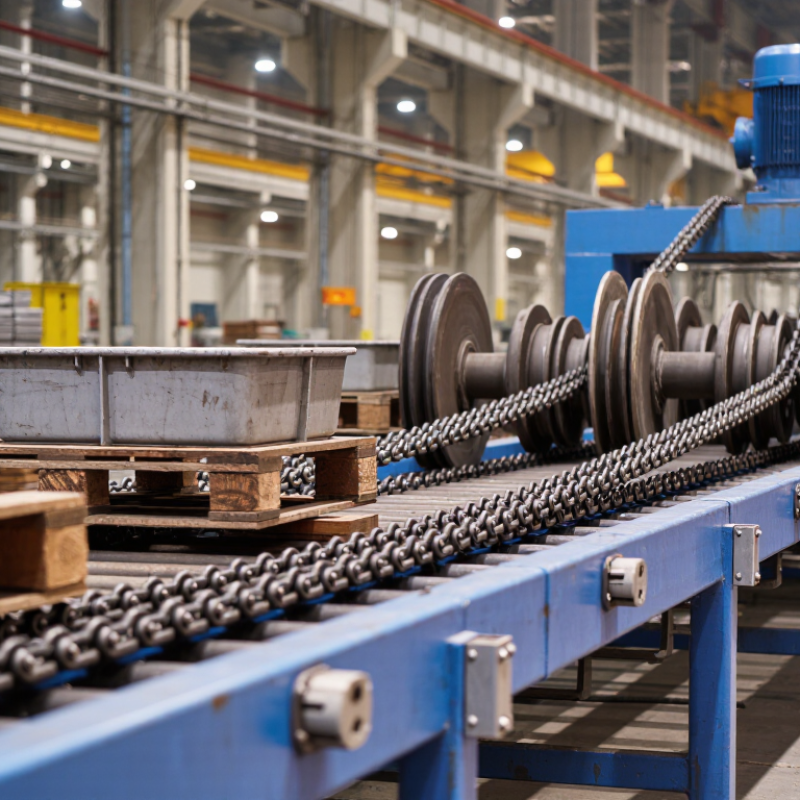
An Industrial Chain Conveyor is a powered handling system built to move heavy, repetitive loads through factories, warehouses, and processing lines. It uses linked chains, sprockets, a drive motor, and a supporting frame. Unlike a belt conveyor, it can carry pallets, bins, steel parts, and products with uneven or abrasive surfaces.
Industrial conveyor engineer H. A. Alspaugh once offered a practical principle: “Design the conveyor around the material, not the other way around.” That advice remains useful. A chain’s pitch, strength, speed, and surface must match the load. A pallet may travel smoothly across steel strands, while a small container could vibrate, tilt, or stop between links. Small details matter.
The motor turns the drive sprocket. The sprocket engages the chain and creates a controlled pulling motion. Flights, rollers, or attachments then support and guide the product. Return rails carry the chain beneath the working surface. Lubrication reduces friction, but excessive lubricant can attract dust and create maintenance problems.
The system looks simple.
It is not always simple.
Poor alignment can produce noise, wear, and uneven movement. An overloaded chain may stretch before failure becomes visible. Experienced technicians inspect sprocket teeth, chain tension, bearings, and transfer points during routine checks. They also listen for changes in sound. Field experience often reveals problems that a specification sheet misses.
This guide explains how an Industrial Chain Conveyor works, where it performs best, and which design decisions influence reliability, safety, and operating cost. It also considers limitations, because no conveyor suits every material or production environment.
What Is an Industrial Chain Conveyor?
What Is an Industrial Chain Conveyor?
An industrial chain conveyor moves products with linked chains driven by powered sprockets. The chain travels along a steel frame, carrying pallets, containers, or heavy components. Some systems use one chain strand, while others use parallel strands for balanced support. Flights, slats, or attachments can hold products in position. A motor and gearbox provide controlled movement. As the sprockets rotate, they pull the chain forward. The return section then guides the chain back beneath the conveying surface.
Tips: Match the chain type to the load, speed, temperature, and working environment. Check sprocket alignment during installation. Even small misalignment can create noise, vibration, and uneven wear. Keep guards in place around moving parts, and follow qualified safety procedures during inspection.
The conveyor’s performance depends on more than motor power. Product weight, transfer spacing, incline angle, and surface friction all affect reliable operation. Regular checks should include chain tension, lubrication requirements, guide rails, and unusual sounds. A practical mistake is choosing a stronger chain without reviewing the frame or drive system. The conveyor may carry the load, but its structure may not. Dust, moisture, and repeated shock can also shorten service life. A design that looks efficient on paper may need adjustment after real production begins. That is why measured testing and careful maintenance remain essential.
What Is an Industrial Chain Conveyor and How Does It Work?
| Data Dimension | Typical Information | How It Relates to Operation |
|---|---|---|
| Basic Definition | A powered conveying system that uses one or more endless chains to move products, pallets, fixtures, or bulk materials. | The chain forms a continuous loop and transfers mechanical force from the drive unit to the conveyed load. |
| Main Drive Components | Electric motor, gearbox, drive shaft, sprocket, chain, return sprocket, and supporting frame. | The motor rotates the gearbox and drive shaft; the sprocket engages the chain rollers or bushings to produce linear movement. |
| Common Conveyor Arrangements | Single-strand, double-strand, multiple-strand, tabletop chain, drag chain, slat chain, and overhead chain configurations. | The arrangement is selected according to product size, load distribution, orientation, and whether the conveyor runs horizontally, vertically, or on an incline. |
| Typical Conveyor Speed | Approximately 0.05–1.5 m/s for many industrial applications; some specialized systems operate outside this range. | Speed depends on product stability, chain type, payload, transfer requirements, noise limits, and the required production rate. |
| Load Capacity | From a few kilograms per meter to several tonnes per meter, depending on chain size, number of strands, frame strength, and support spacing. | The allowable load must include the product weight, pallets or fixtures, friction, acceleration forces, and any incline-related forces. |
| Chain Pitch | Common industrial chain pitches include approximately 25.4 mm, 38.1 mm, 50.8 mm, 76.2 mm, and 101.6 mm. | A larger pitch generally supports heavier loads and larger sprockets, while a smaller pitch can provide smoother movement and tighter transfer spacing. |
| Chain Materials | Carbon steel, stainless steel, nickel-plated steel, and engineered polymer components are commonly used. | Material selection depends on tensile strength, corrosion exposure, hygiene requirements, temperature, wear, and operating environment. |
| Conveyed Products | Pallets, cartons, containers, drums, metal parts, automotive components, wooden products, and bulk materials. | Flights, slats, attachments, carriers, or a pan can be added to improve product support and prevent slipping or shifting. |
| Typical Conveyor Width | Approximately 150–2,000 mm for many packaged-product and pallet-handling systems. | Width is determined by the product footprint, required clearance, number of chains, side guides, and loading method. |
| Operating Temperature | Standard systems commonly operate around −10°C to 80°C; high-temperature designs can be engineered for substantially higher temperatures. | Temperature affects lubricant performance, chain elongation, material strength, seals, and the suitability of polymer components. |
| Incline Capability | Horizontal conveying is most common; inclines are often designed up to approximately 15°–30°, depending on the product and chain attachment. | Inclined conveying requires sufficient traction, product containment, and additional power to overcome the component of gravity acting along the conveyor. |
| Tensioning Method | Adjustable take-up units, tensioning screws, spring take-ups, or automatic tensioning devices. | Correct tension prevents excessive sag, tooth skipping, vibration, accelerated wear, and unnecessary bearing loads. |
| Power Requirement | Small conveyors may use motors below 1 kW, while heavy-duty systems may require several kilowatts or more. | Motor sizing is based on load, conveyor length, speed, friction, acceleration, incline angle, and the efficiency of the drive system. |
| Advantages | High load-handling capability, positive engagement, reliable indexing, durable construction, and suitability for harsh environments. | The positive drive reduces belt slippage and allows controlled movement of heavy, hot, wet, abrasive, or irregular products. |
| Limitations | Higher noise, greater weight, more lubrication requirements, and potentially higher maintenance than some belt conveyors. | Poor alignment, inadequate lubrication, excessive tension, or contamination can increase wear and reduce chain and sprocket life. |
| Routine Maintenance | Inspect chain elongation, sprocket teeth, guides, bearings, fasteners, guards, lubrication, and motor or gearbox condition. | Regular inspection helps identify wear, misalignment, abnormal noise, overheating, and unsafe operating conditions before failure occurs. |
| Common Applications | Assembly lines, pallet handling, packaging, material transfer, heat-treatment lines, automotive production, warehousing, and mining. | The conveyor can be configured for accumulation, indexing, continuous transport, transfer between workstations, or controlled positioning. |
Note: The values shown are representative industrial ranges. Actual specifications should be confirmed through load calculations, operating conditions, safety requirements, and conveyor design standards.