What Is a Lifted Golf Cart?
A Lifted Golf cart is a standard golf cart raised higher above the ground with a lift kit or modified suspension. The added clearance can help it travel over uneven paths, gravel, and shallow ruts without the chassis scraping as easily. Many lifted carts also have larger tires, which change their appearance and may affect how they handle. More room underneath. But extra height alone does not make a cart suitable for every surface.
The term Lifted Golf often describes a style of cart, not one fixed setup. Lift height, tire size, suspension design, and the cart’s original specifications all matter. A modest lift may feel different from a taller build with heavy tires. Drivers may notice changes in steering response, braking, and stability, especially on slopes or during sharp turns. These effects depend on the cart and its condition, so claims about performance deserve a close look.
Before choosing a lifted cart, check the lift kit’s compatibility and ask how the modifications affect routine maintenance. Look closely at the tires, steering components, brakes, and suspension. A taller stance can be appealing, but it may also raise the center of gravity. That trade-off is easy to overlook. The best choice depends on where the cart will be driven, who will use it, and whether its parts have been installed and maintained properly. A careful inspection matters more than a dramatic stance.
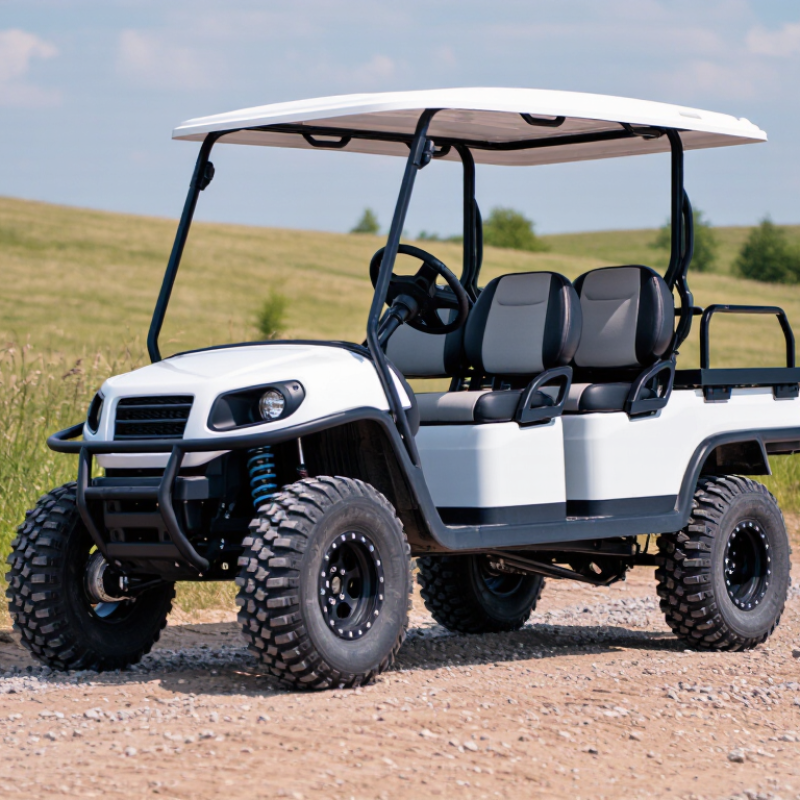
What Defines a Lifted Golf Cart? Typical 3–6-Inch Suspension Lift Kits
What Is a Lifted Golf Cart?
A lifted golf cart sits higher than a standard cart because its suspension has been modified. Typical suspension lift kits add about 3–6 inches of ground clearance. That extra space can help the cart clear ruts, roots, and uneven paths without scraping its underside. The exact height depends on the cart’s design and the kit’s components.
A kit may use raised spindles, brackets, longer springs, or replacement shocks. Some designs change how the suspension and steering connect, so compatibility matters. A three-inch lift can provide modest clearance while keeping the step-in height manageable. A six-inch lift allows more room for larger tires, but can make entering the cart less convenient. Check tire clearance at full steering lock, not just while parked.
More height is not automatically better. A higher center of gravity may affect cornering, especially on sloped ground or with passengers aboard. Installation can also change steering feel, so fasteners, alignment, and tire pressure deserve careful checks. On a gravel track, extra clearance is useful; on tight turns, the taller stance may feel less settled. That trade-off is easy to underestimate. A qualified technician can confirm whether the lift suits the cart’s frame, intended load, and usual terrain.
Lift Types and Components: Spindles, A-Arms, and 3–6-Inch Lift Heights
A lifted golf cart sits higher to clear larger tires, uneven paths, or shallow ruts. Lift kits commonly use spindle or A-arm designs. Spindle kits raise the front by changing the spindle assembly; they are often simpler, but can leave suspension travel close to stock. A-arm kits replace the control arms, creating more room for tire movement and potentially improving clearance over rough ground. The trade-off is more parts to fit and align. Small details matter.
Aftermarket listings commonly specify 3-, 4-, or 6-inch lifts, but those figures describe nominal kit height, not guaranteed ground clearance. Tire diameter, suspension condition, and cart model all change the final measurement. Measure under the frame before and after installation, on level ground. That simple check is easy to skip. ANSI/ITSDF B56.8-2020 provides safety requirements for personnel and burden carriers, but it does not set one universal golf-cart lift height. A taller stance can also raise the center of gravity and affect handling, especially on slopes. Recheck steering, brake lines, and wheel alignment after installation; fitment charts are useful, but they cannot reveal every worn component.
Golf Cart Lift Heights: 3–6 Inches
Lift kits are commonly described by their nominal lift height. The chart shows the 3-, 4-, 5-, and 6-inch options; availability varies by cart and kit design.
Lift components: Spindle lifts raise the cart by replacing or relocating the spindle assembly. A-arm lifts use replacement control arms to change suspension geometry and typically require more suspension components. The stated lift height is nominal; actual ground clearance also depends on tires and the cart setup.
Wheel and Tire Fitment: Common 22–23-Inch Tires on Lifted Carts
On a lifted golf cart, 22- and 23-inch tires are common choices, but diameter alone does not confirm fit. A 22x11-10 size describes nominal tire diameter, section width, and wheel diameter. The Tire and Rim Association’s Year Book provides industry reference dimensions and rim-fitment ranges; compare its specifications with the exact tire you plan to use. Actual mounted height can vary with tread design, wheel width, and inflation. Measure the cart at rest, then check clearance at full steering lock and suspension compression.
Measure twice.
A lift creates room, not unlimited room. A 23-inch tire may rub a fender, inner body panel, or suspension part when turning over uneven ground. Check the wheel offset, bolt pattern, and tire load rating against the cart’s requirements. The U.S. Tire Manufacturers Association’s tire-care guidance advises following vehicle-maker inflation recommendations rather than treating the sidewall maximum as a target. That matters for ride, handling, and tire wear.
A practical test is slow: turn tightly, cross a small bump, and inspect for fresh rub marks. Fitment charts help, but they do not account for every cart’s age, alignment, or added cargo. I would not assume two carts with the same lift height accept the same tire.
Ride, Handling, and Clearance: Effects of Raising the Cart’s Center of Gravity
Raising a golf cart changes more than the space beneath its frame. A lift kit can increase ground clearance for ruts, roots, and uneven paths, but it also raises the cart’s center of gravity. That extra height can make the body lean more noticeably in a turn. The basic relationship is simple: rollover resistance generally falls as center-of-gravity height increases relative to track width. Small changes matter. Tire size, suspension setup, passenger load, and cargo placement all affect how the cart responds. A taller cart may feel steady at walking speed, then feel less composed on a sloped path.
Expect a different ride. On a lifted cart, a sharp turn can produce more body roll, while rough ground may feel less settled. Reduce speed before corners, keep loads low, and avoid abrupt steering. A 2008 Pediatrics analysis of U.S. emergency-department data estimated 147,696 golf-cart-related injuries from 1990 through 2006. That study did not isolate lifted carts, so it cannot quantify the added risk from a lift. It does, however, underline why handling changes deserve attention. Not a guarantee. A careful test on level ground, followed by cautious driving on familiar terrain, can reveal whether the setup feels predictable—or simply taller.
Use and Compatibility: Lifted Carts with 36- or 48-Volt Power Systems
A lifted golf cart sits higher on larger tires, which can help it clear ruts, gravel, and uneven paths. The added height also changes handling and may increase strain on steering, brakes, and the drivetrain. Lifted does not mean more powerful. Grand View Research estimated the global golf cart market at $2.89 billion in 2023, reflecting broad demand for carts with varied configurations. That market figure does not tell you whether a particular cart can accept a lift kit.
Voltage matters. A 36-volt cart commonly uses six 6-volt batteries; 48-volt layouts may use six 8-volt batteries or four 12-volt batteries. These are common arrangements, not a compatibility guarantee. Check the cart’s wiring diagram, controller, motor, charger, and battery chemistry before changing tires or suspension. A mismatched charger can damage batteries, while larger tires can make a cart feel slower and place extra load on the motor. The SAE J2358 golf-car safety standard addresses vehicle performance and safety, but it does not certify every lift-and-battery combination. Measure tire clearance at full steering lock, and have a qualified technician check braking and steering afterward. Small details matter. Even a modest lift can expose a weak connection or worn component.
