
A Longer Laser Cutter can make long panels, signs, and furniture parts easier to handle without repositioning each piece. But a bigger bed is not automatically the better choice. The machine must fit your workspace, materials, and daily workflow. Measure the longest items you expect to cut, then leave room around the machine for loading, ventilation, and routine maintenance. A tape measure on the workshop floor can reveal problems a product photo will not.
This guide shares seven practical tips for choosing a longer laser cutter, from usable bed dimensions and cutting capability to software, construction, service, and safety features. Check the manufacturer’s specifications carefully, and confirm whether listed dimensions describe the work area or the machine’s outer footprint. These numbers are easy to confuse. Ask suppliers about compatible materials and recommended operating conditions, rather than relying on broad claims about cutting performance. Consider how often you will process full-length stock, too; occasional projects may not justify a larger installation.
Think beyond the purchase price. Power requirements, extraction, delivery access, and replacement parts can all affect ownership. A longer machine may need more space than expected, and moving it later can be difficult. That part is often overlooked. Compare several models against real jobs you plan to make, and verify key details with the manufacturer or a qualified dealer. No checklist removes every uncertainty, but a careful comparison can help you choose equipment that suits your work rather than simply occupying more room.
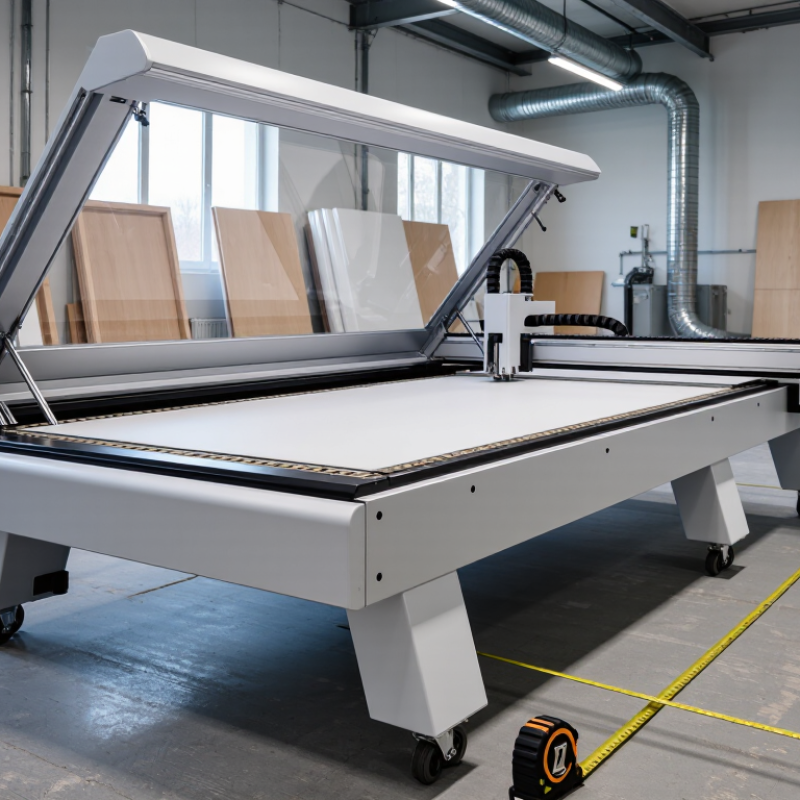
A 3,000 mm bed can suit stock cut into shorter blanks; a 6,000 mm bed may reduce repositioning when workpieces approach six metres. Compare usable cutting travel, not just the advertised bed length. Clamps, loading stops, and lead-in space can limit the actual part length. A long bed also needs safe support along the stock, plus enough floor space for loading and unloading.
Tip: Measure the real job. Record your longest regular stock, not an occasional outlier. Add the clearance your operator needs at both ends, then ask the supplier to confirm usable travel and support points. A 6,000 mm option may be wasteful if most jobs use short pieces. It may also slow handling if long stock is awkward to move. I would check this with a real production layout; a paper measurement can miss a tight aisle.
For context, the World Steel Association’s World Steel in Figures 2024 reports 1,892.2 million tonnes of crude steel production in 2023. That figure describes global output, not local stock lengths, so confirm available formats with your material supplier. Test both bed options against actual order records: stock length, remnant size, and setup time. A simple cut plan can expose a costly mismatch.
When choosing a longer laser cutter, match its wavelength to the materials you actually process. A CO₂ laser, usually operating at 10.6 μm, is well suited to wood, acrylic, paper, and many fabrics. Its energy is absorbed by these non-metallic materials, helping produce clean cuts when focus and power are properly set. For a long bed, also consider whether the beam stays consistent from one end to the other.
A fiber laser, typically near 1.06 μm, is often the better fit for metals such as stainless steel and aluminum. It can mark or cut many metals, but performance depends on the machine’s power, optics, and material thickness. Don’t assume it will handle every plastic well; some plastics respond poorly or require specific settings. Test a scrap.
Before buying, run sample cuts on the exact materials and thicknesses you expect to use. Check edge quality at both ends of the work area, not just near the laser head. Ventilation, assist gas, and focus can change results, too. A wavelength guide is useful, but it isn’t a guarantee. That distinction is easy to miss.
A longer cutting bed does not automatically mean greater cutting thickness. Check the manufacturer’s material chart for the exact material, thickness, and recommended settings. A stated maximum may apply only to one sheet type and a slow, carefully tuned pass. Not every material behaves alike. Dense or coated stock can cut differently from clean, uniform sheet, even at the same thickness.
Look for charts that state power, speed, focus position, and assist-air conditions. These details show what the rating assumes. Compare the listed thickness with the stock you plan to process, and leave room for sheet-to-sheet variation. A small test cut can reveal scorching, incomplete separation, or a wide kerf before you commit to a full job. Keep a simple log of settings and results; it helps with repeat work. I treat charts as a starting point, not a promise. If a supplier provides only one maximum figure, ask how it was measured. That check may prevent choosing a machine that meets a headline rating but struggles with your routine materials.
How to use this chart: These are examples of commonly available sheet-stock thicknesses, not guaranteed cutting capacities. Before choosing a cutter, check the manufacturer’s material chart for the specific material and thickness you plan to cut. Leave a margin below the rated maximum, since results depend on material composition, condition, and machine settings.
For a long-bed laser cutter, check axis accuracy across the full travel, not just near the home position. ISO 230-2 provides a structured method for evaluating positioning accuracy and repeatability on numerically controlled axes. Ask for results at multiple points along the long axis, approached from both directions. Small errors add up.
A useful report identifies the measuring instrument, test conditions, and measured deviations. A calibrated laser interferometer is commonly used, but setup matters: poor alignment or temperature changes can distort results. Check whether the machine was warmed up and tested in conditions similar to your workshop. Also ask how the controller’s compensation affects the reported figures.
Treat the test as evidence, not a guarantee of cutting quality. A machine can position well without proving that every cut will stay accurate across a long sheet. Verify the installed cutter with a practical job, such as repeated marks near both ends of the bed. Compare measurements, and note any difference after reversing direction. One test may miss daily drift; I would not ignore that possibility.
A longer cutting bed changes more than the size of the work area. Under IEC 60825-1, a laser’s class depends on accessible emissions and operating conditions, not output power alone. Check the classification and safety documentation for the exact machine configuration. An enclosure, access panel, or material pass-through can affect how exposure is controlled.
Look closely at openings for long stock. A board extending through the machine may leave a beam path or reflected light accessible beyond the enclosure. Ask how the design limits access during operation, and whether guards or interlocks cover relevant openings. Interlocks help, but they are not a substitute for suitable guarding. Small gaps matter.
Consider the whole installation. Long sheets need stable support so they do not sag, shift, or contact moving parts. Check that extraction reaches the cutting area and that the surrounding space supports safe fire monitoring. Use protective eyewear only when the risk assessment calls for it, and match it to the laser’s wavelength and required protection level. Keep the machine’s classification and safeguards in mind after adding extensions or changing its setup. It is easy to assume a longer bed is just more room; that assumption deserves a second look. A checklist can miss an awkward pass-through, especially when stock sizes vary. Verify the actual arrangement with the manufacturer’s documentation or a qualified laser-safety professional.
Copyright © 2025 · All Rights Reserved · Franchino Mold & Engineering