What Is Peptide Packaging Boxes Used For?
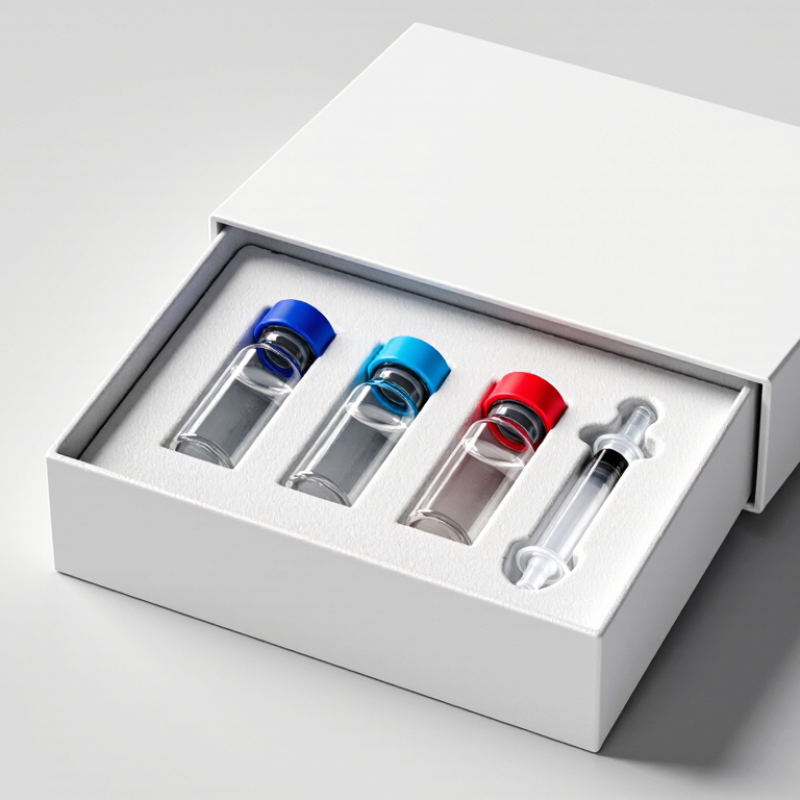
Peptide Packaging Boxes are designed to protect, identify, and present peptide-based products during storage and distribution. They may hold sealed vials, bottles, syringes, or small laboratory containers. Their structure helps reduce crushing, movement, light exposure, and moisture contact. The exact design depends on the product, container, transport conditions, and applicable quality requirements.
A well-designed box often includes custom inserts, clear labeling areas, tamper-evident features, and space for batch information. These details support traceability and reduce handling mistakes. In pharmaceutical and research settings, packaging teams commonly review material strength, print accuracy, closure performance, and shipping tests. A practical example is a fitted insert that keeps a glass vial upright inside a corrugated carton. Small details matter.
Packaging also communicates professionalism and controlled quality. Clean typography, measured color use, and consistent branding can help customers recognize authorized products. However, appearance cannot replace verified protection. A premium-looking box may still fail under humidity, vibration, or temperature changes. That point is easy to overlook.
Manufacturers should select materials through documented testing and consult relevant regulatory or quality specialists. Packaging claims must remain accurate and easy to verify. They should not imply safety, effectiveness, or storage performance without supporting evidence. Sustainable materials may reduce waste, but they still need adequate strength and barrier properties. Sometimes, the simplest box performs best. The right solution balances protection, compliance, usability, cost, and responsible design.
Peptide Packaging Boxes: Roles in Protection, Identification, and Shipping
Peptide Packaging Boxes: Roles in Protection, Identification, and Shipping
Peptide packaging boxes protect sensitive contents from pressure, moisture, light, and sudden temperature changes. Their value begins with structure. A rigid outer box reduces crushing during warehouse handling and delivery. Internal inserts keep vials or containers separated. Small movements can still create problems.
Identification is equally important. Clear labels should show the product name, strength, batch number, storage conditions, and expiry date. A readable two-dimensional code can support traceability across receiving and inventory checks. The World Health Organization highlights traceability and controlled storage as important elements in pharmaceutical supply systems. Packaging also supports professional handling when several similar containers share one shipment. Confusing labels are dangerous.
Shipping adds another layer. A box may face vibration, stacking pressure, humidity, and temperature changes. The International Safe Transit Association recommends performance testing that reflects real distribution conditions. A 2023 Smithers pharmaceutical packaging report also identified compliance, product protection, and supply-chain efficiency as major market priorities. Estimates vary, but the message is consistent: packaging is part of quality control, not decoration.
Tips: Select materials with documented barrier performance. Test the packed box before regular shipping. Use a temperature indicator when storage conditions require evidence. Avoid oversized interiors; empty space allows movement. Review labels under ordinary warehouse lighting. No package is perfect. Packaging choices should be checked against the peptide’s actual stability data, not assumptions.
What Are Peptide Packaging Boxes Used For?
Peptide packaging boxes support three core functions: protecting the product from physical and environmental risks, identifying the contents through clear labeling, and preparing the shipment for safe handling and delivery. The chart counts common packaging tasks associated with each role; it is a practical checklist view rather than market-share data.
How USP <671> Guides Moisture and Barrier Performance for Peptide Packs
What Is Peptide Packaging Boxes Used For?
Peptide packaging boxes protect primary containers during shipping, storage, and handling. However, the carton alone rarely controls moisture. The vial, blister, pouch, closure, and desiccant work as one packaging system.
This distinction matters because many peptides are moisture-sensitive, especially in lyophilized form. Humidity can affect cake structure, potency, and reconstitution behavior. USP General Chapter <671> evaluates package performance through moisture vapor transmission and related weight-loss testing. It does not approve one universal box design. Instead, it supports evidence-based barrier selection for the complete pack.
ICH Q1A(R2) defines long-term testing at 25°C/60% RH and accelerated testing at 40°C/75% RH. These conditions help reveal moisture ingress during stability studies.
A glossy carton can look reassuring, yet appearance is not performance. Industry packaging outlooks from Smithers also identify barrier protection and material efficiency as major pharmaceutical packaging priorities. Still, a report cannot replace product-specific testing. Peptide concentration, fill volume, closure torque, and storage duration can change the result.
Tips: Start with USP <671> moisture testing on the finished package. Compare high-barrier films, coated cartons, and desiccant options under defined humidity conditions. Record seal integrity, not only visual quality. Small failures matter. Recheck after transport simulation, because vibration and temperature cycling may weaken closures. Cite the exact test method, exposure time, and acceptance criteria in the packaging specification.
Why 2–8°C Cold-Chain Boxes Support Peptide Stability During Transit
Peptide packaging boxes are used to protect temperature-sensitive peptide products during storage and transit. Their main task is not decoration. They help control heat exposure, physical impact, moisture, and handling delays. A properly selected box combines insulated walls, qualified coolants, and secure internal spacing. This reduces direct contact between containers and frozen packs. It also limits movement inside the parcel.
For many formulations, a 2–8°C cold-chain box supports stability during transit by slowing temperature changes. Insulation delays outside heat from reaching the payload. Conditioned gel packs then maintain the intended range for a defined duration. The exact duration depends on box size, coolant mass, route, season, and opening frequency. A temperature logger should record conditions throughout shipment. Evidence matters more than appearance.
Peptide stability is formulation-specific, so 2–8°C should never be treated as a universal promise. Packaging teams should review stability data, route risks, and handling instructions before shipping. Qualification tests may examine hot and cold profiles, vibration, and delivery delays. A box can look impressive and still fail after a weekend in a loading yard. That possibility deserves attention. Small gaps matter. Overpacking can also create freezing risks near the coolant. Unconditioned packs may undermine the design. Reliable packaging is a controlled system, not simply an insulated carton.
Which Tests Verify Peptide Box Quality: WVTR, OTR, and ISTA 3A
Peptide packaging boxes are used to shield temperature-sensitive products from moisture, oxygen, light, and physical shock. Their performance depends on more than printed appearance. A box may look rigid, yet its inner barrier can weaken during storage or transport. ICH Q1A(R2) identifies moisture, oxygen, light, and temperature as important stability factors for pharmaceutical products.
WVTR measures how much water vapor passes through a packaging material. Laboratories commonly report it in grams per square meter per day, following ASTM F1249.
Lower values generally indicate stronger barrier protection.
OTR measures oxygen movement, usually in cubic centimeters per square meter per day, using ASTM D3985.
Lower values generally indicate stronger barrier protection.
However, there is no universal pass limit. The required target depends on peptide sensitivity, fill volume, storage duration, and the complete packaging system. A supplier might specify WVTR below 0.1 g/m²/day, but that value is not automatically suitable.
ISTA 3A examines parcel shipping risks, including drops, vibration, compression, and atmospheric conditioning. Its protocol reflects real distribution stress, not just laboratory neatness. WHO Technical Report Series No. 1025 emphasizes controlled storage and distribution conditions for medical products.
A box can pass WVTR and OTR testing, yet fail after repeated drops.
That is the uncomfortable part.
Testing should include filled samples, seals, labels, and inserts. Results should show sample size, conditioning time, test temperature, and failure observations. One missing detail can weaken a confident conclusion.
